Posts mit dem Label Film Review werden angezeigt. Alle Posts anzeigen

Film Review: Nandita Das - Firaaq (India, 2008)

>> Mittwoch, 5. Januar 2011


Nandita Das - Firaaq (India, 2008)

Indian cinema offers a lot more than Bollywood and while people in America and Europe are currently discovering the pleasures of watching acting scions Shah Rukh Khan and Aishwarya Rai at work, there are also films that deal with the reality of India.

Nandita Das’ debut and to date only film deals with the 2002 riots in Gujarat when the ever present tensions between Hindus and Muslim reached a boiling point and several thousand Muslims were murdered in communal riots. A blanket of silence is being spread over the actual events, in reality as well as in the film. We see only the peripheral events and the aftermath as we follow the interwoven stories of several protagonists, Hindu and Muslim alike. But contrary to much of real life India, where life as usual continues in the face of tensions, riots and bombings, Firaaq attempts to grapple with the issues and to show that they, indeed, leave a trace.

The film opens with two men who are digging a mass grave, sighing prayers as they work, shoveling earth and shifting bodies. They are Muslims and so are the corpses. A delivery truck comes and the sight is greeted by dismay by the two men. As it unloads its freight we can see why – stacked on top of each other like sacks of rice, more corpses tumble out of it as soon as the back doors are opened. The men continue their work, until the older of them sees something. One of the bodies is the corpse of a Hindu woman. He loses himself in a fit of madness and makes to beat the woman dead again with his shovel and to strangle her with his bare hands. He is barely held back by his partner and breaks down in sobs.

Indian reality is something that is very hard to come to terms with and closing one’s eyes to anything but the issues that immediately concern oneself is a normal reaction to it. I am grateful for this film which tries to deal honestly and openly with topics that are usually swept under the rug quick as they come.

One strand of the story shows a regular middle class Hindu family. The husband is a greedy, nationalistic man who enjoys sitting around with his crony brother-in-law and talking about money while they are being served by his wife, who is also taking care of his invalid father. But she is inexplicably distracted and keeps opening the door when nobody knocks, her thoughts turning her away from the moment. It turns out that she is haunted by the memory of a Muslim woman who appeared, beaten and bloodied, in front of her window and implored her to let her in before they would kill her. She has ignored the woman and the memory comes back, tormenting her over and over again. She sees a chance for redemption when she encounters a small Muslim boy while she goes shopping and so she takes him with her, pretending that he has been sent by a friend to help out and changing his name into a Hindu name so nobody would become suspicious.

Deception is a common thread in all the stories, but usually the deceivers are acting out of impulses of love and protectiveness. The servant of an elderly Muslim singer keeps news of the rioting away from his master, because he does not want to shatter the old man’s world. This is perhaps the most touching of the stories – the singer has an artist’s hope and faith in the world, something that is worth to be preserved. It’s an astonishingly sensitive portrait.

The friend of a young Muslim girl presses a tilak on her forehead to make everyone think that she is a Hindu when they go to apply Henna to the hands of a newlywed Hindu bride and her friends. The girl herself is despondent and seething with anger – the house that she had lived in with her husband and child has been burned down and she distrusts her friend and neighbour, even as she is trying to protect her, because she refuses to tell her who burned the house down.

The Muslim husband of a Hindu wife gives his wife’s last name when given a receipt by two pandits asking for temple donations. The couple is planning to move away from Gujarat and to Delhi, to flee from the oppression and uncertainty that he feels.

A group of young Muslim men, among them the grave digger and the husband of the Henna artist look for a gun that a shopkeeper has hidden. Once they find it, it becomes the supreme symbol and tool of their vengeance – they file down the single bullet that they own so it fits into the gun and make grand plans of revenge. But as they realize the limitations that their new tool of vengeance offers them, they almost immediately begin to quarrel. It’s only one bullet, so who gets to use it?

As bleak and unremitting as the start of the film is, by the end there is a lot or at least a little of hope for many of the characters, as they see the crisis as an opportunity for change and even growth. The film feels raw, at times almost like an attempt to exorcize all the demons it evokes. Some are there to stay, but others can be chased away by remembering humanity and finding courage.

Read more...

Film Review: Joel & Ethan Coen - True Grit (America, 2010)


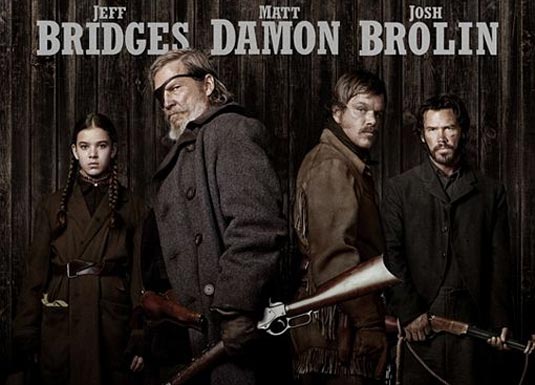
Joel and Ethan Coen – True Grit (2010)

The second foray into the Western genre for the Coen Brothers proves to be much more lighthearted and old-fashioned than their first, but also packs significantly less punch. While No Country for Old Men can be seen as a bleak meditation and a modern Western, True Grit is a very straightforward film, a classical throwback Western. It’s much better than the horribly cynical A Simple Man, their last outing (although the sublimely creepy dibbuk introduction sequence of that film might be one of the best things the brothers ever filmed and makes me wonder what they would do with something like The Golem by Gustav Meyrinck), or the empty and revoltingly stupid Burn After Reading.

By the end of the film I was surprised that it had taken a sudden and rather unexpected turn into classical Hollywood cliché when it tried to up the ante needlessly during what was already a tense resolution sequence. For a moment all the smart and skilled characterization was thrown out of the window to make the protagonists appear more heroic than was needed or simply to get them from one place to the other – it jarred with the rest of the movie, which was kept realistic and interesting by the three excellent leads.

I don’t know the John Wayne original, so I cannot comment on any departures in plot or character. Hailee Steinfeld is excellent as the street-smart fourteen year old Maddie Ross who sets out to find the murderer of her father by all means available, balancing effortlessly between preternatural wisdom and daring and childlike touches. A couple of scenes even seem to play subtly with her maturity and ripening sexuality, which considering that it is an American mainstream feature might not be entirely intended but is still engaging.

Jeff Bridges has a lot of fun with the role of grouchy Marshall Rooster Cogburn, who is kept well this side of realism and is more of an archetype than a true character. Still, few American actors can do this as well as him and he doesn’t slide into the Dude in a Western territory and chooses not to emulate the role that fused him and the Coen brothers together except in little details. Perhaps this is unavoidable, but it doesn’t distract.

Matt Damon plays it relatively safe, but competently so. The banter, with him usually ending up as the butt of the jokes, is often hilarious. He plays the thankless role of straight man with aplomb.

The most effective sequences are the surreal and often exceedingly funny parts for which the Coen brothers are rightly known. The hanged man and briefly afterwards the dentist in the crazed shamanic bear costume must rank as absolute highlights. The darkness is kept to a bearable minimum, mainly because of the absence of cynicism. I found A Simple Man which has zero violence to be so much harder to watch because of the total absence of anything resembling humanity. The actors of True Grit infuse the film with humanity and warmth and turn it into an exciting, if occasionally quirky, mainstream action Western which can almost be considered a family film. Nothing too exciting or daring, True Grit remains a serviceable fare.

Read more...

Film Review: Anton Corbijn - The American (America, 2010)

>> Donnerstag, 30. Dezember 2010


Anton Corbijn – The American (2010)

Having spent a week of the past autumn in Florence and Siena, seeing Tuscany with all its heavy clouds that seem like vast shrouds stretched all the way from the ground to cover the gods high above, is an immediate relief and a joy for me. Much more so since Corbijn, as a photographer, has a keen visual sense and while his Italy is kept significantly cooler than it would be through my own modest lens, it is simply a joy to watch. Good visuals make one relaxed, enable one to take whatever unfolds in reflectively, without the hectic emotional investment that most modern films demand. In that The American reminded me a little of Jim Jarmusch’s wonderful and utterly cool and unflappable The Limits of Control.

The story follows Jack or Eduardo or Signor Farfalle, as he is called in turn by both a prostitute and a female assassin. Jack is an assassin and weapon’s expert. The opening shows him enjoying a beautiful day in a hut in the Northern European woods together with a beautiful woman, who reclines on his shoulder, naked. They get dressed and cross the frozen lake to go into a nearby village when they are attacked by a gunman. He is obviously out for Jack. Jack shoots him, skillfully, and then – after a moment's thought and to the viewer's shock – he shoots the woman in the back of her head.

The film has no obvious explanations, but watching and listening to what is going on, it is not hard to fashion the story. Details are unnecessary and background details are limited and sparse in what turns out to be a highly stylized version of European spy thrillers from the 1970s. The setting is, as already mentioned, Tuscany, where the assassin is sent by his boss to hide out and complete a final mission. Ronin, by John Frankenheimer, is an obvious parallel, but Ronin is fleshy and demonstrative, while The American remains aloof and bordering on a parable.
The nature of his profession makes Jack a loner and supremely paranoid, something which is marvelously played with in a tense picnic scene between Jack and Clara, a prostitute who falls for him. The characters are sketches, but skillful sketches, and it is not hard to project oneself into any of them. Besides Jack and Clara there are a not entirely pure priest who attempts to befriend Jack and a read-headed, steel-eyed female assassin who orders a custom-made gun from Jack. The most effective scenes are scenes that bring the underlying tension close to the surface, although it never breaks it entirely, not even during the few faster moments. The film is slowly paced, rarely demonstrative and never abandons its cool and atmosphere. Everything is hinted at in masterful images, whether it is Jack haunted by the murder of the woman or the laconic and moving climax.

There is not much to say about the film, but it is one of those beautiful things that can be enjoyed in complete silence. I am sure that many people will consider the ending predictable, but that is beside the point. There is enough room for the viewer to arrange all the feelings and all the consequences so that they have the full impact and that alone is a rarity in modern American cinema. Of course this is not an American production - race and cultural context don't play a big role. The American could well be the Outsider and as such he might be a self-portrait of director Corbijn (he pretends to be a photographer), who has spoken about the loneliness of his job and of many travels in interviews.

Read more...

Film Review: Andrzej Munk - Bad Luck (Poland, 1960)


Andrzej Munk – Bad Luck (Zezowate szczescie, 1960)


At the beginning of the film an old man begs an official not to throw him out. He doesn’t want to start again and this place where he is now is the only place where his bad luck has not followed him. He begins to tell his life story, to illustrate just what fate has had in store for him.

So begins the story of Jan Piszczyk, the son of a tailor in Warszaw. We follow his childhood years, his luckless university days and how he meets his first love when he is hired to give her private tuition. We see him as a soldier, a prisoner of war, a lawyer in post-war Krakow and a party official. He streaks through life like a shooting star of misfortune. Whenever something good appears in Piszczyk’s life it is simply the gloss and veneer of some underlying and inevitable bad luck.

Walking through a field towards the military post that has just recruited him, Piszczyk is bombed by German planes, running in slapstick fashion between heads of coleslaw while the bombs explode around him. Heavily delayed he finally arrives in Zegrze, the military school – but it is deserted, raided and empty. He clambers through the rooms, finally finding what he was looking for: a gleaming gala uniform. After he had seen the laughingstock of his school escorting two ladies to a ball, he knew that to count for something he would have to find a uniform (either a priest’s or an officer’s). He is so enchanted by the image of himself in a uniform that he remains completely oblivious to a jeep of German soldiers who enter Zegrze, looking for Polish officers. When they enter the room behind him, he is still lost in a Narcissus gaze at his own image and is promptly captured. What can he tell them? That he just put the uniform on? What, furthermore, can he tell his fellow POWs? He makes up stories that make him out to be a war hero, almost implicating himself in a truly dangerous escape attempt, from which he is only “saved” when another graduate from Zegrze arrives in the prison camp and unmasks him…

Between a rock and a hard place would be a deeply comfortable position for Jan Piszczyk, as he continues tumbling and scratching out a place for himself, always waiting for the inevitable stroke of bad luck. The only time when nothing happens is when he is helping out at his father’s farm since, in his own words, fate probably considered cutting my ears off with a scythe a cheap trick.

A deep sadness is at the core of the upside down world that is presented in Bad Luck – in fact, things are so sad that all you can do is laugh. Cowardice leads to being hailed as a hero while no good deed, as the proverb says, goes unpunished. Piszczyk is cresting the waves of turbulence and as one upset leads him to another, we can get a glimpse at the upturned world of post-war Poland where opportunity goes hand in hand with paranoia and only robust fatalistic humour can get you through. It comes as a small but still very poignant surprise when we learn at the end of the film that the place Piszczyk is so loathe to leave is the state prison.

Andrzej Munk is not a very resonant name today - in 1961 the director from Krakow died aged thirty-nine in a car accident, leaving behind a small but impressive resumé. However, some of Munk's themes, like the cruel jokes that fate plays, turn up mixed into the more metaphysical and gothic films of one of Poland's most famous filmmakers, Roman Polanski, who was an assistant director on Bad Luck.

Read more...

  © Blogger template Webnolia by Ourblogtemplates.com 2009

Back to TOP